
Send Message
Privacy statement: Your privacy is very important to Us. Our company promises not to disclose your personal information to any external company with out your explicit permission.

In mission-critical systems where every milliwatt counts and signal integrity is paramount, the specific performance characteristics of a relay's coil become as crucial as its contact ratings. The JRC-3M 600Ω 27V Military Metal Relay is engineered with a specific high-resistance coil, creating a niche for low-power drive applications without compromising on the ruggedness demanded by Military Aviation, satellite subsystems, and advanced industrial controls. This detailed performance analysis provides procurement managers and design engineers with the empirical data needed to validate its integration into systems ranging from Aircraft Engine sensor interfaces to energy-efficient New Energy control circuits.

The defining 600Ω coil resistance at 27VDC is not arbitrary; it creates a distinct electrical profile with measurable benefits.
This low-power profile directly translates to:
Beyond calculated values, the JRC-3M's value is proven through rigorous testing under MIL-SPEC conditions. The following data represents typical verified performance.
| Parameter | Symbol | Verified Performance Data @ 25°C | Test Condition / Note |
|---|---|---|---|
| Coil Resistance | RC | 600 Ω ±10% | Measured at DC, coil unenergized, ambient 25°C. |
| Must Operate Voltage | VOP(MIN) | ≤ 18.0 VDC | Guaranteed pull-in across full temperature range. At 25°C, typical value is ~15.5VDC. |
| Must Release Voltage | VRE(MAX) | ≥ 2.5 VDC | Guaranteed dropout voltage. At 25°C, typical release is ~1.2VDC. |
| Nominal Operate Time | tON | 8 ms (max.) | Time from 90% of rated voltage applied to contact closure. Slightly longer than low-R coils due to lower initial current surge. |
| Nominal Release Time | tOFF | 5 ms (max.) | Time from 10% of rated voltage to contact open. |
| Initial Contact Resistance | RCONT | ≤ 75 mΩ (Average across poles) | Measured at 1A DC, 6V OC. Demonstrates high-quality contact material critical for PCB Signal Relay-level signal integrity. |
| Insulation Resistance | RINS | > 10,000 MΩ | At 500VDC, between all mutually insulated elements. |
| Dielectric Strength | - | 750 V RMS, 60Hz for 1 min. | Between coil and contacts, and across open contacts. No breakdown or flashover. |
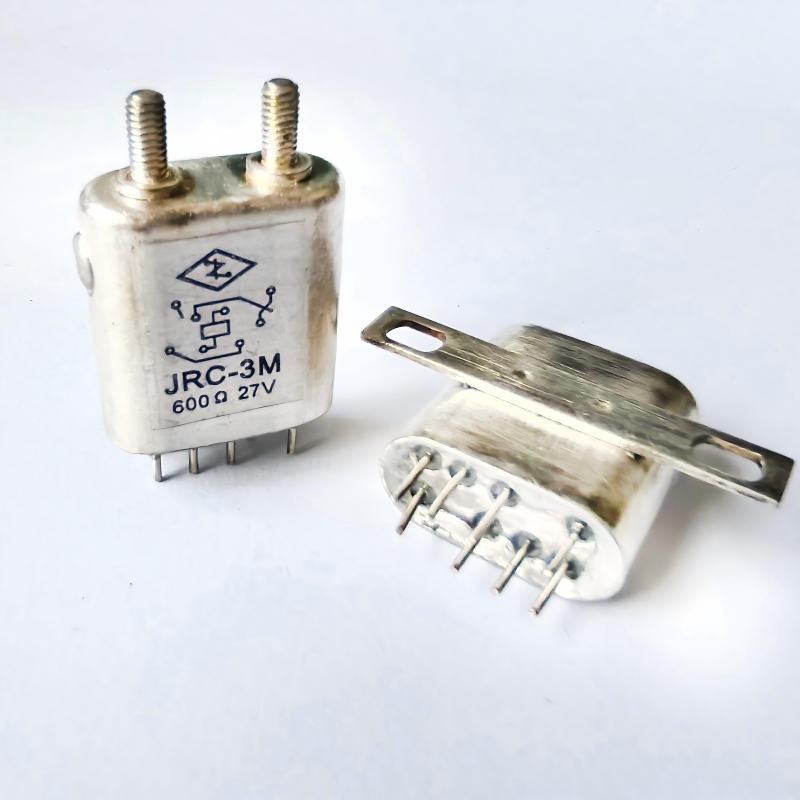
Data validating performance under stress:

Leading OEM/ODM Manufacturers now require more than datasheet limits; they need statistical performance distributions to feed into their reliability prediction models (e.g., using Siemens Polarion or similar PLM tools). The trend is toward suppliers providing digital data packages (DDPs) for components like the JRC-3M. These DDPs include histograms of operate time, scatter plots of contact resistance vs. temperature, and Weibull analysis of life test data, enabling more accurate system-level FMEA and MTBF calculations.
The reliability of the published performance data is rooted in our statistical process control. Within our 650,000 sq.m. Smart Manufacturing Campus, every JRC-3M relay is part of a closed-loop data ecosystem. Key parameters like coil resistance, pull-in voltage, and final contact resistance are measured for every unit. This data is not just used for pass/fail—it is aggregated and analyzed in real-time. SPC charts monitor process stability, ensuring the mean and variance of every parameter stay within strict limits. This allows us to provide lot-specific performance summaries and guarantees that the relay you receive performs within the statistical norms of our published data, a cornerstone of our High Quality Aviation promise.

Our R&D team has developed a proprietary non-contact contact resistance monitoring system used during life testing. Using precise thermal and magnetic sensors, it can infer contact resistance in real-time without intrusive wiring that could affect results. This technology provides unprecedented insight into contact wear dynamics, allowing us to refine materials and designs. The data from this system directly validates the long-term contact stability claim and has also informed improvements in our Latching Relay and Polarized Relay designs for even lower and more stable contact resistance.
To correctly apply the JRC-3M's performance data in your design:

The performance data for the JRC-3M is generated in strict accordance with the test methods prescribed in MIL-PRF-6106 and referenced environmental standards. It is critical to understand that these standards define not just the "what" but the "how": the exact test circuit configurations, measurement instrument specifications, and preconditioning procedures. This standardized methodology ensures data is comparable across manufacturers and over time, giving procurement managers confidence in its validity for qualifying the component into Military Aviation or other high-reliability systems.
A: The operate time is governed by the L/R time constant of the coil and the rate of magnetic field buildup. While a higher resistance (600Ω) gives a smaller L/R time constant, it also results in a lower initial current surge for a given applied voltage (Ohm's Law: I=V/R). The magnetic force is proportional to current. Therefore, the lower initial current in the 600Ω coil leads to a slightly slower acceleration of the armature, resulting in a longer, but highly consistent and bounce-minimized, operate time. This is a deliberate trade-off favoring low power consumption and reliability over ultra-high speed.
A: The JRC-3M's contact rating (2A) applies. You must check the inrush current of the larger relay's coil. A typical automotive relay coil might have an inrush of 3-5A. Switching this load exceeds the JRC-3M's make/break rating and will drastically shorten its life per the electrical life data. For this application, the JRC-3M should drive a small buffer transistor or MOSFET, which then drives the power relay coil. This uses the JRC-3M within its signal-switching capability.

March 17, 2026

December 12, 2025

December 12, 2025

December 12, 2025
Email to this supplier
March 17, 2026
December 12, 2025
December 12, 2025
December 12, 2025
Contact

Send Inquiry
Related Products List
Privacy statement: Your privacy is very important to Us. Our company promises not to disclose your personal information to any external company with out your explicit permission.
Fill in more information so that we can get in touch with you faster
Privacy statement: Your privacy is very important to Us. Our company promises not to disclose your personal information to any external company with out your explicit permission.