RXF-11 Aviation Fuel One-Way Valve – High-Performance Check Valve for Aircraft Fuel Systems
Product Overview
The RXF-11 Aviation Fuel One-Way Valve is a precision-engineered, in-line check valve designed to prevent reverse flow in military and civil aircraft fuel systems. This normally-closed, spring-loaded poppet valve allows fuel to flow freely in the forward direction and seals tightly against reverse flow, ensuring reliable fuel management, engine feed, and cross-feed isolation. Built to withstand aviation fuels (JP-8, Jet A-1, TS-1), wide temperature extremes (-55°C to +150°C), and high vibration environments, the RXF-11 delivers bubble-tight shut-off with minimal pressure drop. As a critical component in YM’s aviation fluid control portfolio – which includes Aviation Valve T-5T, Cold Air Solenoid Valve QDF-42A, Aviation Hand Valve YSF-1A, Aviation Temperature Sensor ZWH-2, and Hydraulic Filter MQL-5 – the RXF-11 ensures safe, efficient fuel transfer for fighter jets, transport aircraft, helicopters, and ground support equipment.
Technical Specifications
Pressure & Flow Ratings
- Media: Aviation fuel (JP-8, Jet A-1, TS-1, AvGas), diesel, and compatible petroleum-based fluids
- Cracking pressure (forward): 1.5 – 3.0 psi (0.1 – 0.2 bar) – low pressure drop for efficient flow
- Maximum operating pressure: 300 psi (20.7 bar)
- Proof pressure: 450 psi
- Burst pressure: 750 psi
- Flow coefficient (Cv): 2.2 – 3.5 (depending on port size)
- Internal leakage (reverse direction): ≤1.0 × 10⁻⁴ sccm (helium tested – bubble-tight)
- External leakage: ≤10⁻⁵ Pa·m³/s (hermetic seal on body joints)
Temperature & Materials
- Operating temperature (fluid & ambient): -55°C to +150°C
- Body material: 303 or 316 stainless steel (corrosion resistant)
- Seat & seal material: FKM (Viton®) – compatible with jet fuels; PTFE or Perfluoroelastomer options available
- Spring material: 17-7 PH stainless steel (corrosion resistant, high cycle life)
- Internal wetted surfaces: Passivated and electropolished (Ra ≤0.4μm)
Environmental & Mechanical
- Vibration resistance: 20g RMS, 10-2000Hz per RTCA/DO-160 Section 8
- Shock: 50g, 11ms half-sine
- Ingress protection: IP67 (hermetically sealed body)
- Weight: ≤220g (depending on port configuration)
- Port size: 1/4” NPT, 3/8” NPT, or MS33649 flare fitting (AN816/815)
- Orientation: Any position (spring-loaded poppet works independent of gravity)
All specifications are qualified per MIL-STD-810 and MIL-DTL-83731. The RXF-11 is designed for 10⁶ operational cycles without degradation.
Product Images & Visuals
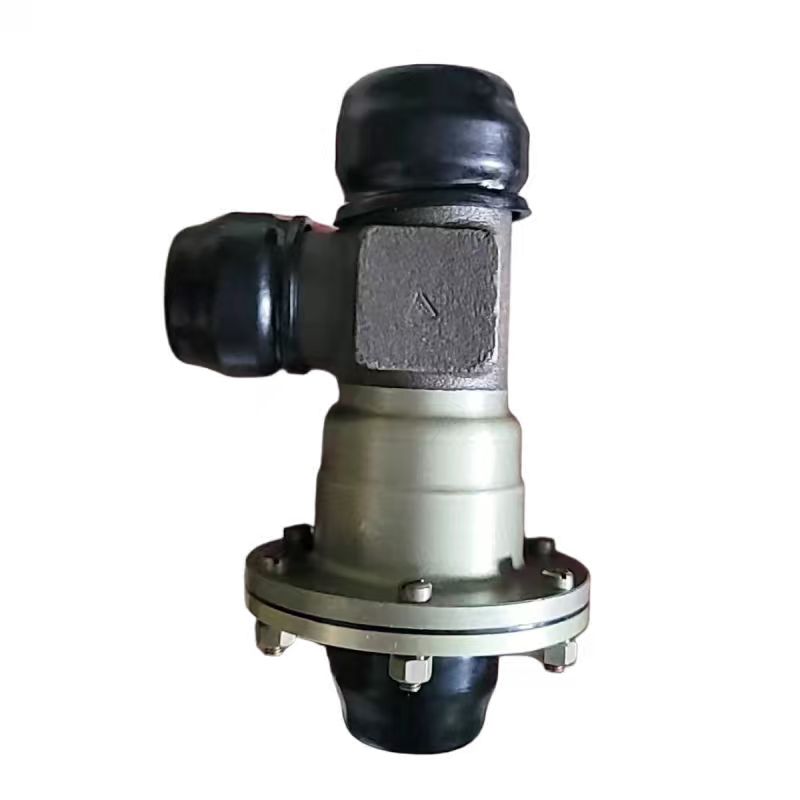
Above: RXF-11 series one-way fuel valve (1/4” NPT ports shown). Contact YM for dimensional outline, flow curve, and environmental qualification reports.
Key Features & Advantages for Aviation Fuel Systems
- Bubble-tight reverse sealing: Precision poppet and seat achieve near-zero reverse leakage, preventing fuel migration and ensuring correct fuel distribution between tanks and engines.
- Low cracking pressure & minimal pressure drop: Cracking pressure of 1.5–3.0 psi and Cv up to 3.5 reduce pumping losses and improve fuel system efficiency.
- Wide temperature & media compatibility: -55°C to +150°C range supports all-weather operations; compatible with all standard aviation fuels and additives.
- Robust stainless steel construction: Corrosion-resistant body and internal components withstand harsh fuel environments and long service life.
- Hermetic sealing: Welded or thread-sealed body construction eliminates external leakage – meets stringent environmental and fire safety requirements.
- MIL-SPEC compliant: Designed to MIL-DTL-83731 (check valve, fuel) and tested per MIL-STD-810G (vibration, shock, temperature, humidity, salt fog).
YM’s engineering advantage: The RXF-11 check valve shares proven sealing technology with our Aviation Valve T-5T and Aviation Hand Valve YSF-1A, ensuring consistent performance across all fuel management applications. For complete fuel system monitoring, YM also offers Aviation Temperature Sensor GWR-1, Fuel Pressure Transducer, Oxygen valve QF-21A, and Electronic Horn for status indication.
How to Install & Use the RXF-11 Fuel Check Valve – Step by Step
- Verify direction arrow: The valve body is marked with a flow direction arrow (or “IN/OUT”). Ensure the arrow points from the fuel source (tank/pump) toward the engine or downstream system.
- Pre-installation inspection: Check for any shipping damage, debris inside ports, and verify thread type (NPT, MS flare, etc.). Clean with approved solvent if necessary.
- Mounting: Install the valve in-line using appropriate fittings. For NPT ports, apply MIL-PRF-46010 thread sealant and torque to 15-25 Nm (1/4” NPT). For MS flare, use clean flare fittings and tighten to specified torque. Do not over-tighten.
- Leak test (after installation): Pressurize the fuel line to nominal operating pressure. Apply a soap solution to both ports and body joints – no bubbles indicate proper sealing. For high-sensitivity applications, use a helium leak detector.
- Functional test: With fuel flowing in the forward direction, verify that the valve opens (pressure drop across valve should be <1 psi at rated flow). Apply reverse pressure (e.g., by closing downstream valve) – confirm zero reverse flow using a flow meter.
- Maintenance: The RXF-11 is maintenance-free for the life of the aircraft (10⁶ cycles). Periodically inspect for external fuel stains or corrosion. Replacement seal kits are available for overhaul.
Pro tip for fuel system designers: Install the check valve downstream of the fuel pump and upstream of any filter to protect the pump from backflow and maintain filter prime. For multi-tank aircraft, place one valve per tank outlet to prevent cross-feed.
Application Scenarios & Key Buyer Benefits
Typical Military & Civil Aviation Uses
- Engine fuel feed lines: Prevents fuel from draining back to tanks when engine is off – ensures rapid start and eliminates vapor lock.
- Cross-feed & transfer systems: Allows fuel to flow from auxiliary tanks to main tanks but prevents reverse flow during refueling or unbalanced conditions.
- Fuel pump outlet protection: Installed downstream of boost pumps to prevent backflow when pump is off, reducing pump wear and cavitation.
- Ground refueling nozzles & carts: One-way valve prevents spillage when disconnected – improves safety and reduces fuel waste.
- Fuel filtration & sampling ports: Isolates filter housings and test points from main fuel lines during maintenance.
Direct Value to International Buyers (Defense OEMs, MROs, Fuel System Integrators)
- Enhanced safety: Bubble-tight reverse sealing prevents fuel migration and potential fire hazards – meets MIL-STD-882 and JSSG-2009 requirements.
- Reduced maintenance: No moving seals to adjust or replace – stainless steel spring and poppet provide >10⁶ cycle life without performance degradation.
- Improved fuel efficiency: Low cracking pressure (1.5 psi) and high Cv reduce pumping losses, saving fuel and extending aircraft range.
- Supply chain consolidation: The RXF-11 is form-fit-function compatible with legacy check valves (e.g., Eaton, Parker, Honeywell) – simplifies fleet upgrades and spare parts inventory. YM also supplies complementary sensors such as fuel pressure transducer, industrial pressure transducer, and Aviation Temperature Sensor ZWH-2 for complete fuel system health monitoring.
For new aircraft programs, YM offers customization of cracking pressure, flow coefficient, and port configurations to meet specific fuel system requirements.
Certifications & Compliance
- MIL-STD-810G (environmental – temperature, vibration, shock, humidity, salt fog, sand/dust, altitude).
- MIL-DTL-83731 (valve, check, fuel and oil).
- RTCA/DO-160G (airborne equipment – Category A2, S, and R).
- AS9100D (aerospace quality management system).
- Fire resistance: Meets FAR 25.981 (fuel tank ignition prevention) – valve body and seals self-extinguish.
- REACH / RoHS compliant – full material declaration available.
Each RXF-11 valve is 100% tested for cracking pressure, forward flow (Cv), reverse leakage (mass spectrometer), and external leakage. Lot traceability per AS9100 is maintained. First Article Inspection (FAI) reports per AS9102 are provided upon request.
Customization Options
YM supports tailored RXF-11 variants for specific aircraft platforms and fuel system architectures. Volume orders can include:
- Cracking pressure: 0.5 psi (low) to 10 psi (high) – to match pump and system backpressure requirements.
- Port configuration: NPT, MS flare (AN815/816), SAE O-ring boss (ORFS), or custom flange.
- Orifice size & Cv: From 0.8 to 5.0 Cv for different flow rates (e.g., APU vs. main engine feed).
- Seal material: FKM (standard), low-temperature fluorosilicone (-65°C), or PTFE (high-temperature/chemical resistance).
- Body material: 303 SS (standard), 316 SS (marine/corrosive environments), or titanium (weight-critical applications).
- Optional integrated filter screen: 100μm mesh upstream of poppet to protect seat from debris.
- Marking: Laser engraving of customer part number, flow arrow, and pressure rating.
Our engineering team provides feasibility analysis and prototypes for qualified programs. Minimum order quantities apply – contact YM with your specification sheet.
Production Process & Quality Assurance (AS9100D / NADCAP)
YM’s aviation valve production line is designed for zero-defect, fully traceable manufacturing, meeting the strict demands of military and civil aerospace customers.
- Raw material control: 100% certification of stainless steel bar stock, springs, and seals – traceable to mill test reports (MTR) and batch certificates.
- Precision machining: CNC turning and milling with in-process CMM inspection – tolerances held to ±0.01mm on poppet and seat surfaces.
- Deburring & cleaning: Ultrasonic cleaning and electropolishing of all wetted surfaces – particle count per ISO 4406 class 14/12/10.
- Spring calibration & assembly: 100% force testing of each spring; assembly in Class 100 cleanroom with torque control.
- 100% functional & leak test: Cracking pressure verification, flow test (Cv), reverse leakage (mass spectrometer sensitivity 10⁻⁹ sccm), and external leakage (helium spray).
- Environmental sample testing: Each lot undergoes thermal cycling (-55°C to +150°C, 20 cycles), vibration (20g RMS), and life cycle test (10⁵ cycles at rated pressure).
- Final documentation: Dimensional report, flow curve, leak test record, C of C, and FAI (if required) provided with each shipment.
With decades of experience in Aviation Valve and Hydraulic Filter MQL-5 manufacturing, YM has supplied thousands of check valves to global defense and commercial aviation customers. The RXF-11 is built to exceed the stringent requirements of modern aircraft fuel systems.


 Contact Now