JQX-136MD Military Aviation Latching Relay – DPDT Hermetically Sealed Metal Relay for Aircraft, Drone & Engine Control
Product Overview
The JQX-136MD Military Aviation Latching Relay is a high‑reliability, hermetically sealed DPDT (double‑pole double‑throw) relay designed for demanding aerospace, drone, and military applications. Available in 12V DC, 24V DC, and 28V DC coil versions, this true Latching Relay (bistable) maintains its contact state without continuous coil power – ideal for power‑sensitive avionics, battery‑backed systems, and engine control circuits. The JQX‑136MD features a robust Metal Sealing Relay construction (glass‑to‑metal seal) with leakage rate ≤10⁻³ Pa·cm³/s, providing complete protection against moisture, fuel vapors, and altitude pressure changes. With low coil power consumption (0.3–0.43W), fast switching (≤4ms), and high insulation resistance (>500MΩ), this Military Metal Relay is trusted for flight control interfaces, weapon systems, radar, and communication equipment. As a core product in YM’s relay portfolio – which includes Polarized Relay, PCB Board Relay, Automotive Relay, Industrial Power Relay, and PCB Signal Relay – the JQX‑136MD delivers uncompromised performance for aircraft, trains, and ground support equipment.
Technical Specifications
Coil Parameters (Latching, 12V / 24V / 28V DC)
- Nominal coil voltage: 12V DC, 24V DC, or 28V DC (specify when ordering)
- Coil power consumption (pulse): (0.3–0.43)W – ultra‑low for a DPDT latching relay
- Incentive pulse width: (10–50) ms – sufficient to set or reset
- Coil resistance (typical at 25°C): 12V: 330–480Ω; 24V: 1300–1900Ω; 28V: 1800–2600Ω
- Pick‑up voltage (set): ≤75% of nominal
Contact Ratings (DPDT – 2 Form C)
- Contact configuration: DPDT (two independent changeover contacts)
- Maximum switching current: 5A at 28V DC (resistive); 2A at 115V AC 400Hz
- Low level switching capability: (10–50)μA, (10–50)mV – 1×10⁵ operations, ideal for dry circuits
- Reference resistive load (test condition): 1A, 28V DC, 1×10⁵ operations
- Initial contact resistance: ≤50mΩ; after life test ≤200mΩ
Timing & Isolation
- Action time (operate): ≤4ms (typical ≤3ms)
- Release time (reset): ≤4ms
- Dielectric strength (normal atmosphere): 500Vr.m.s., 50Hz between contacts and case; under low pressure (drone altitude): 250Vr.m.s.
- Insulation resistance (normal atmosphere): >500MΩ at 500V DC; after high‑level life test: >50MΩ
Mechanical & Environmental (Aviation Grade)
- Weight: <3g – ultra‑light for airborne electronics
- Sealing (leakage rate): ≤10⁻³ Pa·cm³/s (hermetic, glass‑to‑metal seal)
- Operating temperature range: -65°C to +125°C
- Shock & vibration: Withstands 50g, 6ms half‑sine; 10‑2000Hz, 20g random vibration per RTCA/DO‑160
- Terminal style: Solder hook or PCB through‑hole (gold‑plated)
All parameters are validated at 25°C ambient. The JQX‑136MD is manufactured and tested to MIL‑PRF‑39016 requirements for hermetically sealed relays.
Product Images & Visuals
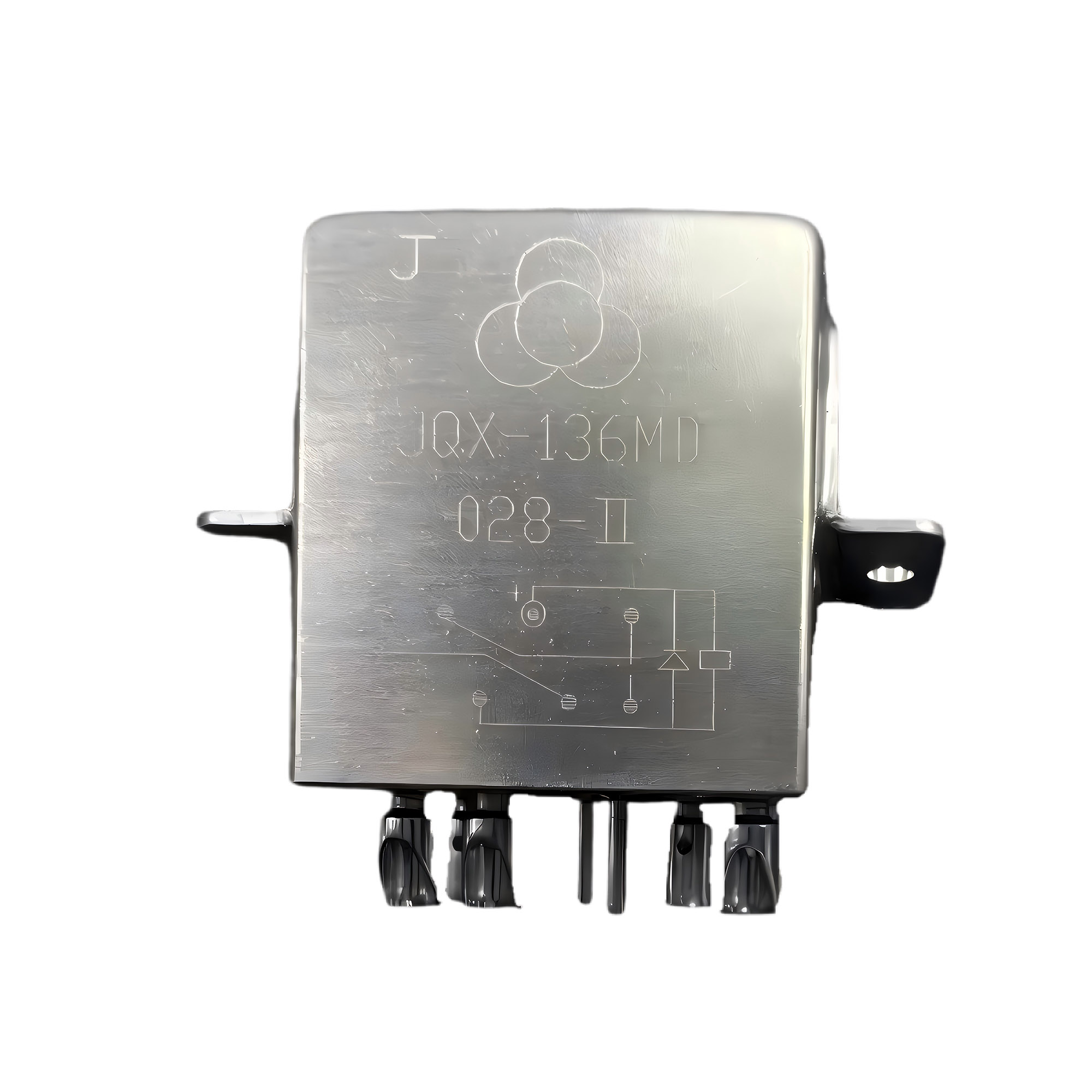
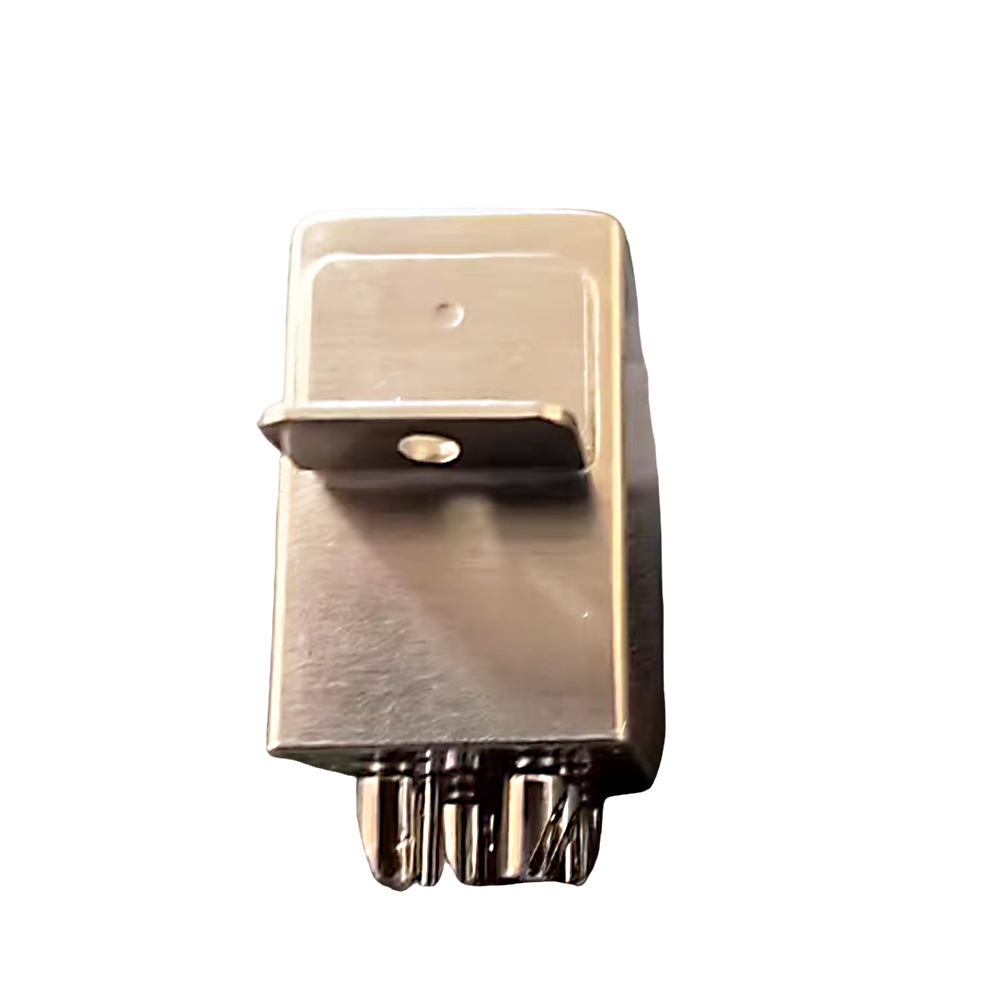
Above: JQX-136MD series hermetically sealed DPDT latching relay. Contact YM for dimensional outline, pin configuration, and environmental qualification reports.
Key Features & Advantages for Military Aviation
- True DPDT latching (bistable) operation: Dual‑coil or single‑coil polarity‑sensitive design – maintains contact state without holding power, reducing system energy consumption by >90% compared to non‑latching relays.
- Hermetic metal sealing (≤10⁻³ Pa·cm³/s): Glass‑to‑metal seal protects against moisture, salt spray, and altitude pressure changes – ensures >20‑year shelf life and reliable operation in unpressurized aircraft bays and engine compartments.
- Ultra‑low coil power (0.3–0.43W): Allows direct drive from avionics logic (e.g., 28V CMOS) with simple pulse drivers – minimizes heat generation and power supply load.
- Fast switching (≤4ms) & high isolation: 500Vrms dielectric strength and >500MΩ insulation prevent crosstalk in mixed‑signal environments – ideal for flight control and weapon systems.
- Wide temperature & vibration tolerance: -65°C to +125°C operation and 20g vibration meet RTCA/DO‑160 and MIL‑STD‑810 requirements – suitable for drone swarms, fighter jets, and railway rolling stock.
- Excellent low‑level signal switching: Gold‑plated contacts reliably switch down to 10μA / 10mV – perfect for sensor multiplexing, avionics I/O, and mission computers.
YM’s engineering advantage: The JQX‑136MD leverages advanced magnetic circuit technology from our Latching Relay and Polarized Relay families, ensuring consistent pull‑in sensitivity across temperature extremes. As a true Metal Sealing Relay, it outperforms commercial DPDT relays in hermeticity and vibration tolerance. For complete avionics signal chains, YM also offers Aviation Button Switch, Aviation Rocker Switch, Military aircraft Plug, Aviation Connector, and Aviation Press Meter – a one‑stop solution for defense contractors.
How to Use the JQX-136MD DPDT Latching Relay – Step by Step
- Identify coil configuration: The JQX‑136MD is typically a dual‑coil latching relay (set and reset coils). Refer to the datasheet for pin assignment (DPDT, 8 or 10 pins).
- Apply set pulse: To close the contacts (common to NO for each pole), apply a DC pulse (nominal voltage, 10–50 ms) to the set coil pins. Do not exceed the rated pulse width.
- State retention: After the pulse ends, the relay remains in the closed state indefinitely without any coil power – zero holding current.
- Apply reset pulse: To open the contacts, apply a DC pulse (same voltage, 10–50 ms) to the reset coil pins. The relay returns to its open state.
- Load connection: Connect your signals or loads (max 5A 28VDC) to the common, normally‑open, and normally‑closed terminals of each pole. For dry circuit applications (μA/mV levels), gold‑plated contacts ensure reliable switching without cleaning.
- PCB mounting: Solder the relay into a socket or directly onto the PCB. Use a heat sink during soldering (max 260°C for 5 seconds). Avoid flux ingress – use no‑clean flux.
Pro tip for avionics engineers: Always initialize the relay state during system power‑up (apply a known set or reset pulse) to avoid indeterminate states. For single‑coil versions, use an H‑bridge driver to reverse polarity.
Application Scenarios & Key Buyer Benefits
Typical Military & Aerospace Applications
- Flight control computers: Discrete I/O expansion, autopilot mode selection, and actuator control – latching holds state without power drain.
- Aircraft engine control: Fuel shutoff, ignition selection, and thrust reverser relays – hermetically sealed for engine bay environment.
- Drone power distribution: Main battery switching, payload isolation, and flight termination systems – ultra‑lightweight and low power consumption.
- Radar & electronic warfare (EW) modules: Signal routing and antenna switching – DPDT configuration allows switching two circuits simultaneously.
- Railway & train systems: Door control, lighting switching, and brake system relays – wide temperature range and vibration resistance.
Direct Value to International Buyers (Defense OEMs, UAV Manufacturers, MROs)
- Reduced system power & thermal load: Zero holding power eliminates coil heating – allows denser packaging in avionics LRUs and reduces cooling requirements.
- Lower lifecycle cost: Hermetic sealing prevents contact oxidation failures, reducing field returns and unscheduled maintenance – critical for remote or space‑based systems.
- Simplified power supply design: Pulse operation eliminates continuous coil drivers and heat sinks – lowers BOM cost and PCB area.
- Global compliance: MIL‑PRF‑39016 qualified, RoHS/REACH compliant, with AS9100D manufacturing – ready for FMS, direct defense contracts, and space agency procurement.
For aftermarket MRO providers, the JQX‑136MD offers a form‑fit‑function replacement for obsolete DPDT latching relays (e.g., Teledyne, CII, Eaton). YM provides cross‑reference guides and sustainment support.
Certifications & Compliance
- MIL-PRF-39016 (hermetic, signal and power relay) – qualification data available upon request.
- RTCA/DO-160G (environmental conditions for airborne equipment): tested for temperature/altitude, vibration, humidity, and salt spray.
- MIL-STD-202 (environmental test methods) – vibration, shock, thermal shock.
- ISO 9001:2015 & AS9100D certified manufacturing (aerospace quality management).
- RoHS 2011/65/EU & REACH (EC 1907/2006) compliant – full material declaration.
- Hermeticity: 100% tested per MIL‑STD‑883, method 1014 – leak rate ≤10⁻³ Pa·cm³/s.
Each production lot is 100% inspected for coil resistance, set/reset voltage, contact resistance (each pole), dielectric strength, and insulation resistance. Sample relays undergo destructive physical analysis (DPA) per MIL‑STD‑1580. Certificates of Conformance (CoC) and test data are provided with every shipment.
Customization Options
YM supports tailored JQX‑136MD variants for specific military, aerospace, and space programs. Volume orders can include:
- Coil voltage: 5V, 12V, 15V, 24V, 28V, 48V DC – customized to match avionics bus or spacecraft power.
- Contact material: Gold overlay (standard for low‑level), AgPd (for mixed load), or Rhodium (for ultra‑low level, <1μA).
- Terminal style & finish: Solder hook, straight DIP, or surface‑mount; gold or tin plating; weldable leads for hybrid microcircuits.
- Sealing enhancement: Internal getter for hydrogen‑sensitive environments (space applications).
- Screening level: Commercial (standard), high‑reliability (100% burn‑in, temperature cycling), or space‑level (DPA, radiation testing, outgassing).
- Marking: Laser engraving of customer part number, date code, or inspection stamp.
Our engineering team provides application support, including thermal derating curves, driver circuit recommendations, and radiation hardness data. Minimum order quantities for custom variants apply – contact YM with your requirements.
Production Process & Quality Assurance (AS9100D Certified)
YM’s Military Relay production line follows a zero‑defect, fully traceable process designed to meet AS9100D and the most stringent customer requirements for military and space programs.
- Incoming material control: 100% verification of magnetic alloys, contact wires, glass preforms, and metal cans – all from approved aerospace suppliers with COC and batch traceability.
- Coil winding & encapsulation: Precision winding with automated tension control; vacuum encapsulation using low‑outgassing epoxy (NASA outgassing compliant).
- Contact assembly in Class 100 cleanroom: Alignment of DPDT contacts under 40x microscope; dynamic contact force measurement to ensure ≤50mΩ initial resistance.
- Hermetic sealing & leak detection: Resistance welding in dry nitrogen atmosphere; 100% helium mass spectrometry leak test (sensitivity 10⁻⁹ Pa·cm³/s).
- Environmental screening (100% for high‑rel lots): Thermal shock (-65°C to +125°C, 10 cycles), constant acceleration (10,000g), and burn‑in (168 hours at 125°C with periodic operation).
- Final electrical test: Automated test system (ATS) measures set/reset voltage, operate/release time, contact bounce, dynamic contact resistance for each pole, and insulation resistance at 500VDC.
- Destructive Physical Analysis (DPA): One unit per lot is cross‑sectioned and examined per MIL‑STD‑1580 for internal workmanship.


 Contact Now