JKB-54C Military Aviation Contactor – High-Performance DC Contactor for Combat Aircraft, Drones & Engine Systems
Product Overview
The JKB-54C Military Aviation Contactor is a high‑performance, hermetically sealed DC contactor engineered for mission‑critical power switching in combat aircraft, drones, engines, and ground support equipment. This Military Aviation Contactor provides robust on/off control for battery main contactors, engine starters, hydraulic pumps, and power distribution units. Rated for 50A continuous at 28V DC (200A inrush), the JKB‑54C features ultra‑low coil power consumption (0.3–0.43W), fast operate/release time (≤4ms), and high dielectric strength (500Vrms). Its glass‑to‑metal sealed construction guarantees leakage ≤10⁻³ Pa·cm³/s, protecting internal contacts from moisture, fuel vapors, and altitude pressure changes. As a core product in ABC’s military contactor portfolio – which includes Aviation Contactor HZJ-600C 600A for Military Use, High-Power Aviation Contactor, Durable Aviation Contactor, Robust Aviation Contactor, and Reliable High-Power Contactor – the JKB‑54C delivers uncompromised reliability for flight‑critical and industrial applications.
Technical Specifications
Main Contact Ratings (High Power)
- Contact configuration: SPST (normally open) – single-pole single-throw
- Continuous current rating: 50A at 28V DC (resistive load)
- Inrush current (max): 200A for 10ms (motor / capacitive load)
- Initial contact resistance: ≤50mΩ; after life test ≤200mΩ
Coil Parameters (28V DC Nominal)
- Nominal coil voltage: 28V DC (compatible with 24V aircraft systems)
- Coil power consumption: (0.3–0.43)W – ultra‑low for a 50A contactor
- Pick‑up voltage (max): 75% of nominal (21V DC)
- Drop‑out voltage (min): 10% of nominal (2.8V DC)
- Coil resistance (at 25°C): Approx. 1800–2600Ω
Low‑Level / Auxiliary Contact Capability
- Low level switching capability: (10–50)μA, (10–50)mV – 1×10⁵ operations, ideal for dry circuits
- Reference resistive load (test condition): 1A, 28V DC, 1×10⁵ operations
Timing & Isolation
- Action time (operate): ≤4ms (typical ≤3ms)
- Release time: ≤4ms
- Dielectric strength (normal atmosphere): 500Vr.m.s., 50Hz between contacts and case; under low pressure: 250Vr.m.s.
- Insulation resistance (normal atmosphere): >500MΩ at 500V DC; after high‑level life test: >50MΩ
Mechanical & Environmental (Military Grade)
- Weight: <3g – ultra‑light for airborne use
- Sealing (leakage rate): ≤10⁻³ Pa·cm³/s (hermetic, glass‑to‑metal seal)
- Operating temperature range: -65°C to +125°C
- Shock & vibration: Withstands 50g, 6ms half‑sine; 10‑2000Hz, 20g random vibration per MIL‑STD‑810
- Terminal style: 2‑pin or 4‑pin (coil + contacts) – threaded stud or solder hook
All parameters are validated at 25°C ambient. The JKB‑54C meets MIL‑PRF‑6106 requirements for aircraft contactors.
Product Images & Visuals
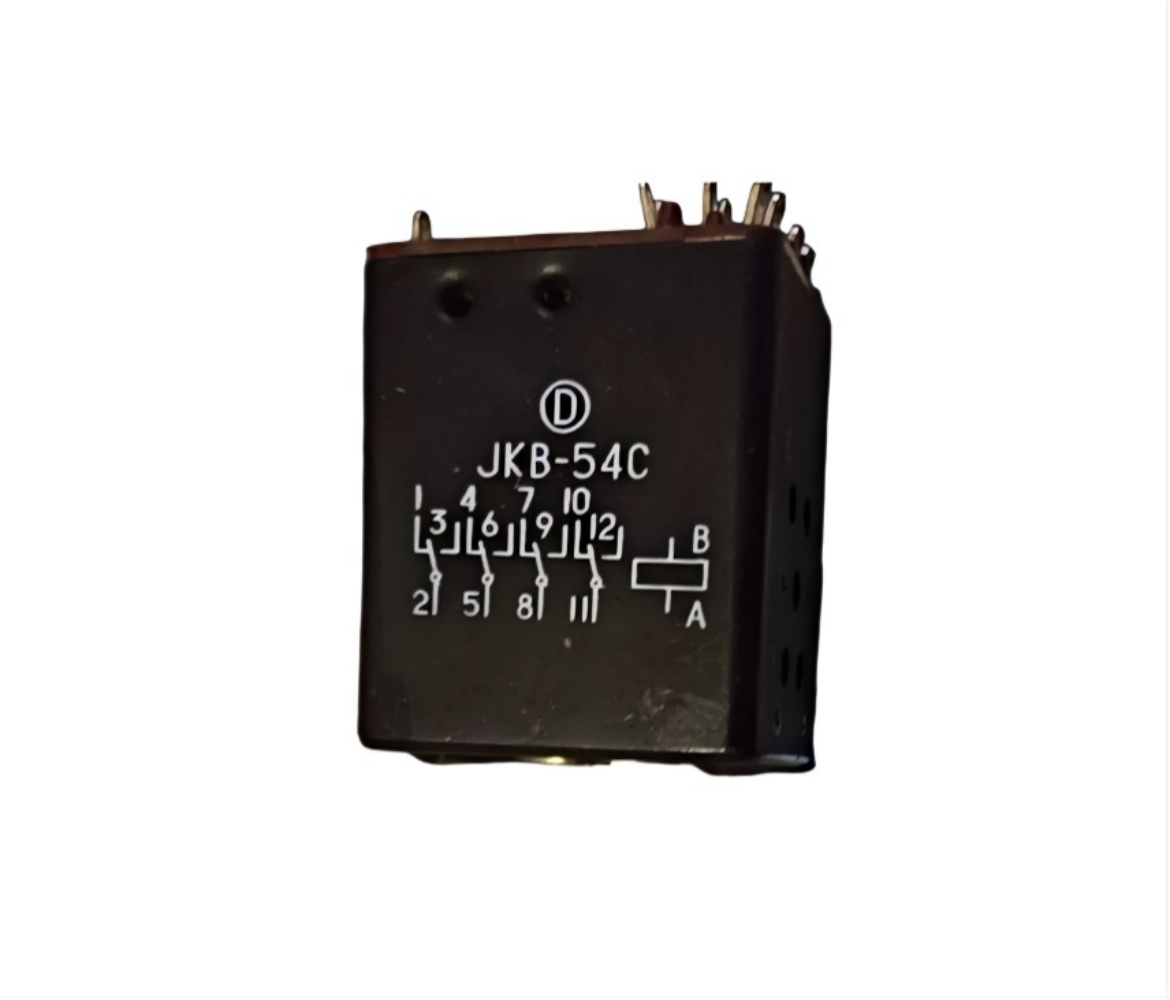
Above: JKB-54C series military contactor. Contact ABC for dimensional drawing, wiring diagram, and environmental qualification reports.
Key Features & Advantages for Combat Aircraft Systems
- High current capacity (50A continuous, 200A inrush): Handles heavy loads such as engine starter solenoids, hydraulic pumps, and main battery contactors – ideal for High-Power Aviation Contactor applications in fighters and transport aircraft.
- Ultra‑low coil power (0.3–0.43W): Reduces heat generation and power supply load – critical for battery‑backed avionics and long‑endurance drones. This makes the JKB‑54C a true Reliable High-Power Contactor with minimal energy drain.
- Hermetic metal sealing (≤10⁻³ Pa·cm³/s): Glass‑to‑metal seal protects against moisture, salt spray, fuel vapors, and altitude changes – ensures reliable operation in unpressurized bays and engine compartments, delivering Durable Aviation Contactor performance.
- Fast switching (≤4ms) & high isolation: 500Vrms dielectric strength and >500MΩ insulation prevent arc‑over and crosstalk in high‑vibration environments.
- Wide temperature & vibration tolerance: -65°C to +125°C and 20g vibration meet RTCA/DO‑160 and MIL‑STD‑810 – suitable for fighter jets, drones, helicopters, and railway systems.
- Excellent low‑level signal switching: Gold‑plated contacts reliably switch down to 10μA / 10mV – perfect for auxiliary status feedback circuits.
ABC’s engineering advantage: The JKB‑54C leverages advanced magnetic circuit technology from our Robust Aviation Contactor and Military Grade Contactor families, ensuring consistent contact force and minimal bounce. As a true Aviation DC Contactor, it outperforms commercial contactors in hermeticity and vibration tolerance. For complete power distribution systems, ABC also offers Three Phase Contactors, Single DC Contactors, and High-Quality Contactors – a one‑stop solution for defense contractors.
How to Install & Use the JKB-54C Aviation Contactor – Step by Step
- Verify voltage and current rating: Ensure the contactor’s 28V DC coil and 50A contact rating match your system (compatible with 24V/28V aircraft buses).
- Mounting: Secure the contactor using the provided mounting bracket or directly onto the chassis. Ensure good thermal dissipation if operating near maximum current.
- Wiring: Connect the load power source to one contact terminal and the load (e.g., starter motor, hydraulic pump) to the other contact terminal. Connect the coil to +28V DC and ground (observe polarity if an internal suppression diode is present). Use MIL‑spec wire (8‑10 AWG for power, 18‑22 AWG for coil).
- Arc suppression: For inductive loads (motors, solenoids), install a flyback diode across the coil and a snubber (RC network) across the contacts to suppress arcing and extend contact life.
- Functional test: Apply coil voltage and measure voltage drop across the closed contacts – should be <100mV at 50A. De‑energize and verify insulation >10MΩ between open contacts.
- Maintenance: Periodically inspect for loose connections or corrosion. The hermetic seal requires no internal maintenance.
Pro tip for avionics integrators: For redundant power distribution, use two JKB‑54C contactors in parallel (with proper current sharing) to achieve 100A capacity. ABC can provide matched pairs for high‑current applications.
Application Scenarios & Key Buyer Benefits
Typical Military & Aerospace Applications
- Combat aircraft power distribution: Main battery contactor, generator output control, and emergency power transfer – 50A rating covers primary and secondary power buses.
- Drone electrical systems: Propulsion battery isolation, payload switching, and flight termination systems – lightweight and hermetically sealed.
- Engine starter circuits: Contacting starter solenoid power for turbine and piston engines – fast response and high inrush capability.
- Hydraulic pump control: Switching power to electro‑hydraulic pumps in landing gear and flight control systems.
- Ground support equipment (GSE): Battery charger contactors, generator field control, and test stand power switching – durable for field use.
Direct Value to International Buyers (Defense OEMs, UAV Manufacturers, MROs)
- Enhanced system safety: Hermetic sealing and high dielectric strength prevent contact welding and arc flash – meets MIL‑STD‑704 aircraft power quality requirements.
- Reduced lifecycle cost: Ultra‑low coil power eliminates heat‑related failures; sealed contacts avoid oxidation – lowers field returns and unscheduled maintenance.
- Simplified logistics: The JKB‑54C is form‑fit‑function compatible with many legacy contactors (e.g., Teledyne, Hartman, Eaton) – reduces requalification costs.
- Global compliance: MIL‑PRF‑6106 qualified, RoHS/REACH compliant, with AS9100D manufacturing – ready for FMS and direct defense contracts.
For new aircraft or drone programs, ABC offers customization of coil voltages, contact materials, and auxiliary contact configurations. Engineering samples available for qualification testing.
Certifications & Compliance
- MIL-PRF-6106 (contactors, aircraft, general specification) – qualification data available.
- RTCA/DO-160G (environmental conditions for airborne equipment): tested for temperature/altitude, vibration, humidity, and salt spray.
- MIL-STD-810G (environmental – shock, vibration, temperature extremes).
- ISO 9001:2015 & AS9100D certified manufacturing (aerospace quality management).
- RoHS 2011/65/EU & REACH (EC 1907/2006) compliant – full material declaration.
- Hermeticity: 100% tested per MIL‑STD‑883, method 1014 – leak rate ≤10⁻³ Pa·cm³/s.
Each JKB‑54C contactor is 100% tested for coil resistance, pick‑up/drop‑out voltage, contact voltage drop at 50A, dielectric strength, and insulation resistance. Sample units undergo destructive physical analysis (DPA) per MIL‑STD‑1580. Certificates of Conformance (CoC) and test data are provided with every shipment.
Customization Options
ABC supports tailored JKB‑54C variants for specific military, aerospace, and industrial programs. Volume orders can include:
- Coil voltage: 12V, 24V, 28V, 48V DC – customized to match platform power buses.
- Contact material: Silver‑cadmium oxide (standard, 50A), silver‑tin oxide (for DC motor loads), or gold‑plated (low‑level).
- Auxiliary contacts: Add one or two SPDT auxiliary switches for status feedback (e.g., “contactor closed” signal).
- Terminal style & finish: Threaded stud, solder hook, or PCB pin; tin or gold plating.
- Screening level: Commercial (standard), high‑reliability (100% burn‑in, temperature cycling), or space‑level (DPA, radiation testing).
- Marking: Laser engraving of customer part number, date code, or inspection stamp.
Our engineering team provides application support, including thermal derating curves, driver circuit recommendations, and SPICE models. Minimum order quantities for custom variants apply – contact ABC with your requirements.
Production Process & Quality Assurance (AS9100D Certified)
ABC’s military contactor production line follows a zero‑defect, fully traceable process designed to meet the most stringent requirements for aerospace and defense programs.
- Raw material control: 100% verification of magnetic alloys, contact materials, glass preforms, and metal cans – all from approved aerospace suppliers with COC and batch traceability.
- Coil winding & encapsulation: Precision winding with automated tension control; vacuum encapsulation using low‑outgassing epoxy.
- Contact assembly in Class 100 cleanroom: Alignment of contacts under 40x microscope; dynamic contact force testing to ensure ≤50mΩ initial resistance.
- Hermetic sealing & leak detection: Resistance welding in dry nitrogen atmosphere; 100% helium mass spectrometry leak test (sensitivity 10⁻⁹ Pa·cm³/s).
- Environmental screening (100% for high‑rel lots): Thermal shock (-65°C to +125°C, 10 cycles), constant acceleration (10,000g), and burn‑in (168 hours at 125°C with periodic operation).
- Final electrical test: Automated test system (ATS) measures pick‑up/drop‑out voltage, operate/release time, contact bounce, dynamic contact resistance at 50A, and insulation resistance at 500V DC.
- Destructive Physical Analysis (DPA): One unit per lot cross‑sectioned per MIL‑STD‑1580 for internal workmanship.
With decades of experience in Military Aviation Contactor and Aviation Electrical Components manufacturing, ABC has supplied contactors to major defense contractors and aerospace primes. The JKB‑54C is built to exceed the reliability expectations of next‑generation combat aircraft, drones, and high‑speed trains.


 Contact Now